

In this wealth series, we will bring you insights from the book The Psychology of Money.
Your personal experiences with money make up maybe 0.00000001% of what’s happened in the world, but maybe 80% of how you think the world works.
Let me tell you about a problem. It might make you feel better about what you do with your money, and less judgmental about what other people do with theirs. People do some crazy things with money. But no one is crazy. Here is the thing. People from different generations, raised by different parents who earned different incomes and held different values, in different parts of the world, born into different economies, experiencing different job markets with different incentives and different degrees of luck, earn very different lessons. Everyone has their own unique experience with how the world works. And what you have experienced is more compelling than what you learn second-hand. So all of us — you, me, everyone goes through life anchored to a set of views about how money works that vary wildly from person to person. What seems crazy to you might make sense to me.
The person who grew up in poverty thinks about risk and reward in ways the child of a wealthy cannot fathom if he tried. The person who grew up when inflation was high experienced something the person who grew up with stable prices never had to. The investor who lost everything during the Great Depression experienced something the tech worker basking in the glory of the late 1990s can’t imagine. The Australian who hasn’t seen a recession in 30 years has experienced something no American ever has. You know stuff about money that I don’t, and vice versa. You go through life with different beliefs, goals, and forecasts, than I do. That’s not because one of us is smarter than the other, or has better information. It’s because we’ve had different lives shaped by different and equally persuasive experiences.
Our personal experiences with money make up maybe 0.00000001% of what’s happened in the world, but maybe 80% of how we think the world works. So equally smart people can disagree about how and why recessions happen, how you should invest your money, what you should prioritize, how much risk one should take, and so on. In his book on 1930s America, Frederick Lewis wrote that the Great Depression “marked millions of Americans inwardly– for the rest of their lives.” But there was a range of experiences. Twenty-five years later, as he was running for president, John F. Kennedy was asked by a reporter what he remembered from the Depression. He remarked: I have no first-hand knowledge of the Depression. My family had one of the great fortunes of the world and it was worth more than ever then. We had bigger houses, more servants, we traveled more. The only thing that I saw directly was when my father hired some extra gardeners just to give them a job so they could eat. I really did not learn about the Depression until I read about it at Harvard. This was the major point in the 1960 election. How people thought, could someone with no understanding of the biggest economic story of the last generation be put in charge of the country? It was, in many ways, overcome only by JFK’s experience in world War II. That was the other most widespread emotional experience of the previous generation, and something his primary opponent, Hubert Humphrey, didn’t have.
The challenge for us is that no amount of studying or openmindedness can genuinely recreate the power of fear and uncertainty. One can read about what it was like to lose everything during the Great Depression. But one cannot have the emotional scars of those who actually experienced it.
Spreadsheets can model the historic frequency of the big stock market declines. But they can’t model the feeling of coming home, looking at your kids, and wondering if you have made a mistake that will impact their lives. We all think we know how the world works. But we have all only experienced a tiny bite of it.
As investor Michael Batnick says, “some lessons have to be experienced before they can be understood.” We are all victims, in different ways, to that truth.
Economic Conditions Decides People’s Investment Decisions :
In theory, people should make investment decisions based on their goals and characteristics of the investment options available to them at the time. But that’s not what people do. The economists found that people’s lifetime investment decisions are heavily anchored to the experiences those investors had in their own generation, especially in their adult life. If you grew up when inflation was high, you invested less of your money in bonds later in life compared to those who grew up when inflation was low. If you have grown up when the stock was strong, you invested more of your money in stocks later in life compared to those who grew up when stocks were weak.
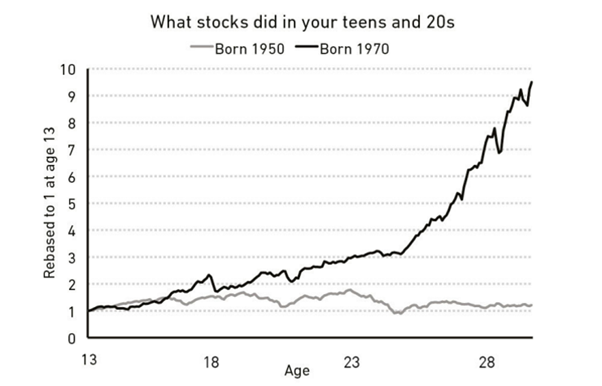
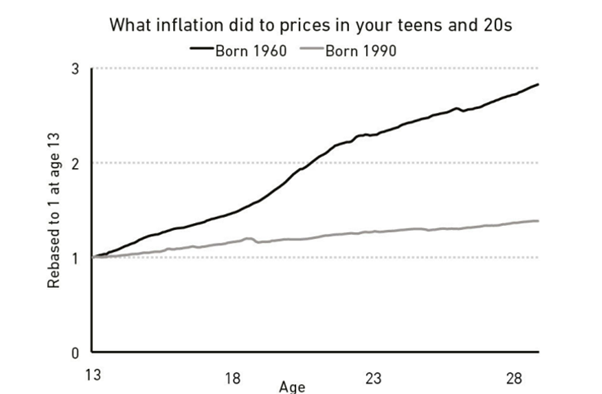
Or inflation. If you were born in 1960s America, inflation during your teens and 20s—your young, impressionable years when you’re developing a base of knowledge about how the economy works—sent prices up more than threefold. That’s a lot. You remember gas lines and getting paychecks that stretched noticeably less far than the ones before them. But if you were born in 1990, inflation has been so low for your whole life that it’s probably never crossed your mind. A few years ago, The New York Times did a story on the working conditions of Foxconn, the massive Taiwanese electronics manufacturer. The conditions are often atrocious. Readers were rightly upset. But a fascinating response to the story came from the nephew of a Chinese worker, who wrote in the comment section: My aunt worked several years in what Americans call “sweatshops.” It was hard work. Long hours, “small” wages, “poor” working conditions. Do you know what my aunt did before she worked in one of these factories? She was a prostitute. The idea of working in a “sweatshop” compared to that old lifestyle is an improvement, in my opinion. I know that my aunt would rather be “exploited” by an evil capitalist boss for a couple of dollars than have her body be exploited by several men. That is why I am upset by many Americans’ thinking. We do not have the same opportunities as the West. Our governmental infrastructure is different. The country is different. Yes, a factory is hard labor. Could it be better? Yes, but only when you compare such to American jobs. Every decision people make with money is justified by taking the information they have at the moment and plugging it into their unique mental model of how the world works. Every financial decision a person makes sense to them at that moment. They themselves a story about what they are doing and why they’re doing it, and that story has been shaped by their own unique experiences. We all do crazy stuff with money because we’re all relatively new to this game and what looks crazy to you might make sense to me. But no one is crazy— we all make decisions based on our own unique experiences that seem to make sense to us in a given moment.
#greatdepression #inflation #Savings #stockmarket #generations #Economy #crazy #wealth #money #psychologyofmoney #spending #america